AI is becoming a place where people think, write, decide, and draft.
Hugonomy builds tools that help people stay aware while using it —
and we want to prove that this kind of feedback actually changes behavior.
Scroll to see the question we are trying to test.
Position statement
Where Hugonomy Stands — A Position, Not a Conclusion
This is a public statement of where my thinking sits at this moment. It is not a
manifesto. It is not a finished theory. It is a marker — so that future versions
of this work can be traced back to what I actually believed, and what I did not yet
know, when I started building.
The observation that motivates this work
Human-AI cognition is a coupled system.
Edwin Hutchins's foundational work on distributed
cognition (Cognition in the Wild, 1995) showed that complex cognitive
tasks — navigating a Navy ship across an ocean, for instance — aren't
performed by individual minds working with tools to help. They're performed by the
whole system: navigator, chart, compass, rangefinder, the bearings being called out,
the procedures, the other crew members, the ship itself. Remove the compass and you
don't have a navigator working without a key tool. You have a fundamentally different
cognitive system that computes position differently. The thinking is in the
configuration. The unit of analysis is the whole functional system, not the individual
mind.
This is what happens when a person works with a generative AI. The thinking is no
longer happening only inside the person's head. It is distributed across the person,
the model, and the artifacts they produce together. And the output of that system can
look indistinguishable whether the person did most of the cognitive work or almost
none of it. The artifact does not reveal who did the thinking.
Prior cognitive tools externalized capability visibly. The calculator shows
you what it computed. The map shows you the route. The compass shows you the bearing,
but not the destination; the large language model shows you the destination, but hides
the bearing. The user always knew where their work ended and the tool's began. Large
language models externalize reasoning itself, and they do so invisibly. A
user can read a fluent answer and feel intellectually involved because they touched
the artifact, while the key reasoning transitions occurred outside them. A programmer
can accept a confident solution before fully modeling its logic. The user often cannot
detect, in the moment, when evaluation stopped and acceptance began.
I want to be clear about what this position is not. It is not anti-offloading.
Cognitive offloading is inevitable, often beneficial, and frequently the right move
— no one should compute compound interest by hand for the sake of cognitive
purity. The concern is not delegation itself. It is unexamined delegation,
where the boundary between human reasoning and machine reasoning becomes invisible to
the human inside the loop. This is the cognitive-offloading problem named by
researchers like Gerlich and Kabashkin, and a concern UIUC's Mary Frances Phillips
and Koustuv Saha raise in their recent commentary. The question is not
whether AI is dangerous. The question is what kind of thinker the human becomes when
most of their thinking is delegable, and they cannot see, in the moment, that the
delegation is happening.
The framework I am operating within
The cognitive dynamic between a human and an AI falls into one of three states.
Negative-sum: the human's capacity atrophies — the system produces good
output, but the person doing the work loses some of their ability to do it without the
AI. Zero-sum: the AI substitutes for the human without growth or loss —
the task gets done, but the human doesn't develop. Positive-sum: the AI frees
the human into thinking they could not have reached alone — the human grows by
working with the system.
Which state any given interaction occupies is set by the human's engagement.
And engagement is precisely the variable that is invisible to both the user and any
external system.
I believe most current AI interactions sit in the zero-sum or negative-sum state by
default. Not because users are careless, but because nothing in the system makes the
cognitive distribution visible to them. The ship's navigator can see the compass. The
AI user cannot see where their thinking ends and the model's begins.
The direction this work is pointed
The dominant response to this problem locates the safeguard inside the AI itself:
train models to refuse when refusal would protect the user from offloading. This is
the work serious people are doing, and it matters. But it is incomplete. Refusal
systems are unreliable, institutional adoption lags, and the user remains the only
party present in every interaction.
Beyond the AI-system layer and the institutional layer, I am building toward a third:
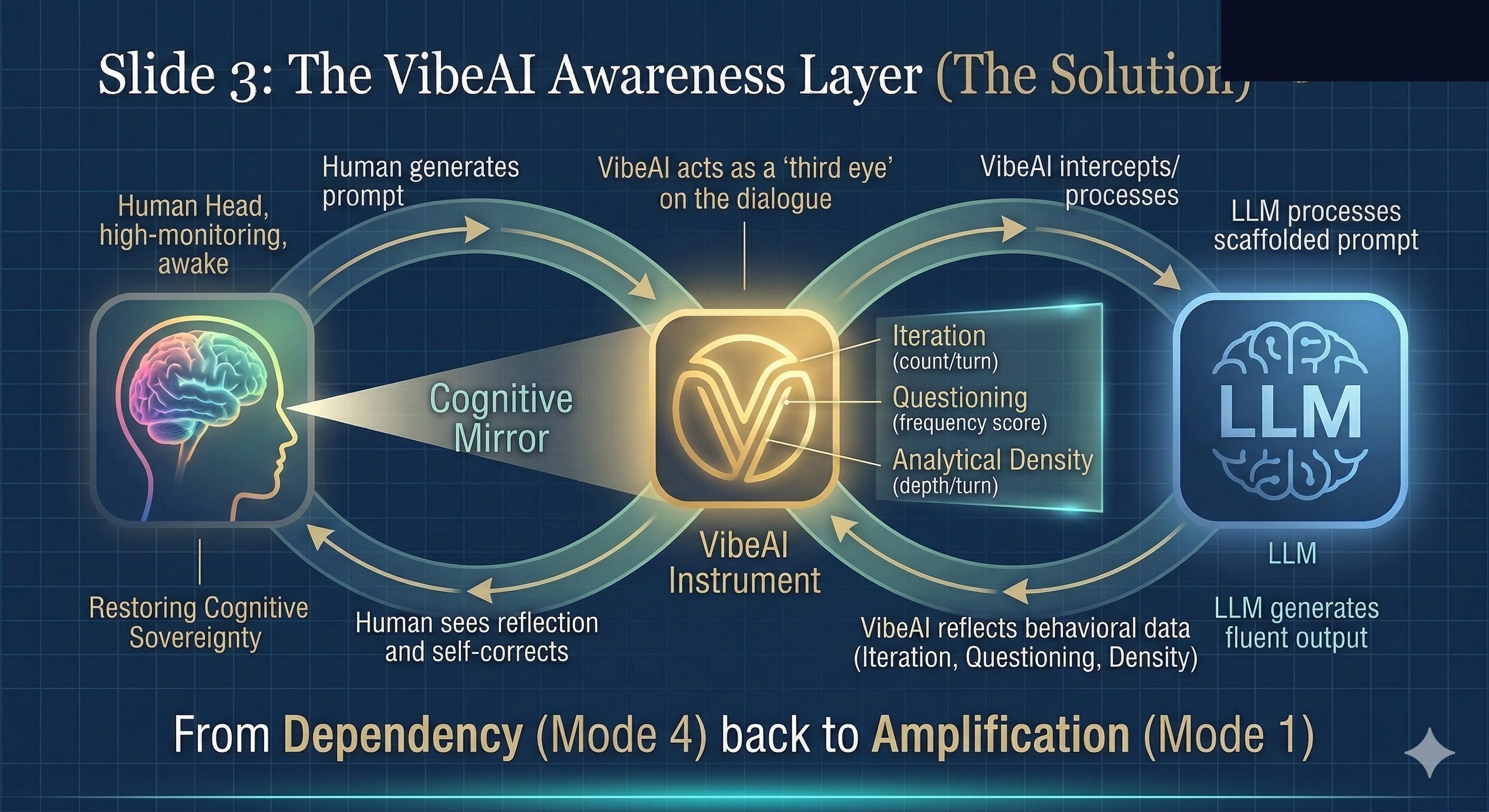
a user-facing reflection layer that makes the user's own cognitive engagement
visible to them in real time, without forcing judgment from the system itself. The aim
is not to police the user. The aim is sovereign awareness — by which I
mean the user's ability to see, evaluate, interrupt, and redirect the thinking
happening across themselves and the system. The user remains the active, governing
party in their own cognition, with the AI serving as the instrument rather than the
agent.
This is the bet. The instrument exists in early form. Whether it works at scale is an
empirical question I cannot answer alone. The work, and this statement, are public so
that the position is on record and the question is examinable.
Click any reference to expand it. Sorted strongest evidence first.
Qazi, I. A., Ali, A., Khawaja, A. U., Akhtar, M. J., Sheikh, A. Z., & Alizai, M. H. (2026). Automation bias in large language model–assisted diagnostic reasoning among physicians trained in AI literacy — A randomized clinical trial. NEJM AI.
The only experimental (not correlational) evidence in this list — 20 hours of AI-literacy training did not prevent automation bias.
Kabashkin, I. (2025). Cognitive atrophy paradox of AI–human interaction: From cognitive growth and atrophy to balance. Information, 16(11), Article 1009.
A theoretical model, not a measurement — the CSI/CAP framework Hugonomy's internal measurement vocabulary is built on.
Hutchins, E. (1995). Cognition in the wild. MIT Press.
The foundational distributed-cognition text — thinking has always been partly external. The question is whether the external part stays reflective or goes passive.
Zhang, Y., Li, M., Han, W., Yao, Y., Cen, Z., & Zhao, D. (2025). Safety is not only about refusal: Reasoning-enhanced fine-tuning for interpretable LLM safety. arXiv preprint arXiv:2503.05021.
Technical grounding on how model-side safety reasoning works — the model-side layer Hugonomy's reception-layer instrumentation sits alongside, not on top of.
Arditi, A., Obeso, O., Syed, A., Paleka, D., Panickssery, N., Gurnee, W., & Nanda, N. (2024). Refusal in language models is mediated by a single direction. Advances in Neural Information Processing Systems, 38.
Mechanistic-interpretability grounding for how models represent refusal internally — background context, not a claim about users.
Early research shows a consistent signal: passive AI use correlates with cognitive decline.
But all of that research measures outcomes after the fact — surveys, post-hoc scores, theoretical models.
Nobody has tested whether real-time awareness feedback actually changes how people engage with AI
while it's happening. We want to be the ones who find out — honestly, rigorously, in public.
And if the answer is no, the world deserves to know that too.
The gap in the current science
"What's missing is a tool that observes how people actually engage with AI while the conversation is happening. Today there is no real-time feedback about how someone is interacting with AI." — Hugonomy advisor pitch, UIUC EIR, March 2026
The hypothesis
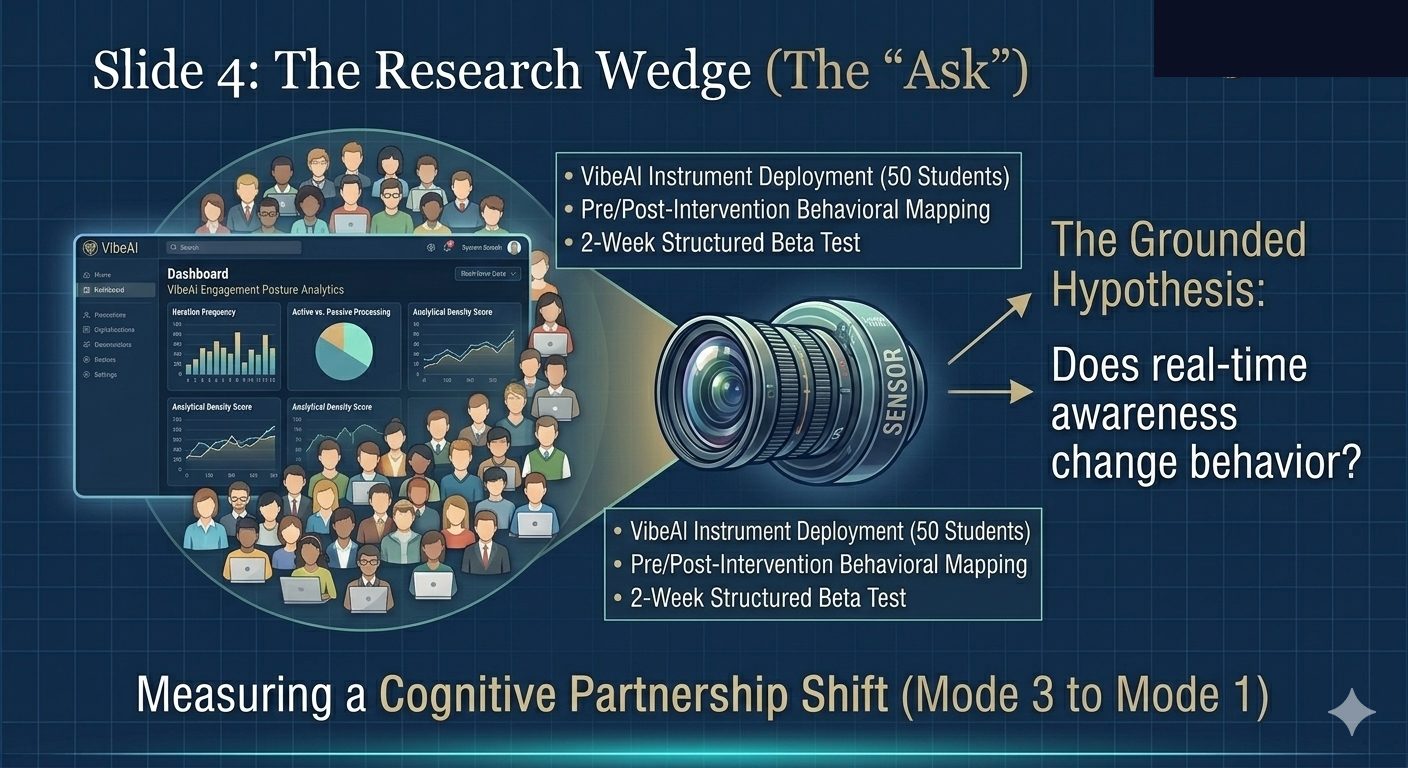
If you can see your own thinking engagement in real time — does it change how you think?
We believe the answer is yes. Real-time awareness of passive acceptance should interrupt the drift before it becomes a habit. But belief isn't science. We want to measure it.
2-week randomized pilot. Treatment group sees live VibeAI FoldSpace cognitive feedback during AI conversations. Control group uses the same AI tools with no engagement feedback shown. Pre/post behavioral mapping.
Participants
n ≈ 50 students. Target: university cohort using AI tools for coursework. Mixed AI usage frequency. Diverse academic backgrounds. Minimal risk — all data stays on device, local-first architecture.
What We Measure
Behavioral: active vs. passive engagement ratio, session persistence, message depth, reflection frequency.
Self-reported: pre/post survey on AI overreliance, mindfulness, and metacognition — your awareness of your own thinking as it happens.
The Grounded Hypothesis
Users who see a real-time "Thinking Engagement" signal will display meaningfully different interaction patterns compared to users without feedback — moving from passive acceptance toward active inquiry.
We are not claiming this works.We are claiming it's worth testing — with enough scientific rigor that the result, positive or negative, adds something real to the field.
If real-time cognitive awareness doesn't change behavior, that finding matters just as much.
The AI era needs honest instruments, not just optimistic ones.
If this question matters to you — we want to hear from you.
We're looking for academic partners, researchers, and institutions willing to help design and run a rigorous pilot. IRB-ready. Local-first architecture. Consent-gated from day one.
University researchersCognitive scientistsEducation technologistsIRB coordinatorsCurious institutions
What exists now, what comes next, and what stays longer-term —
all built around the same rule: notice first, understand second, automate last.
VibeAI FoldSpace™
A real-time awareness HUD for AI conversations. Runs entirely in your browser —
no cloud, no accounts, no profiling. Shows your thinking stage (Exploring, Evaluating,
Refining, Passive Mode) as it shifts. Activates the Thinking Mirror when you accept
an AI response too quickly.
Chrome & Edge · Local-only · Consent-gated
Live now
Next
AllMinds Lens™
Built for cross-session work. Where FoldSpace helps inside one conversation,
Lens is meant to reconnect your thinking across many sessions — with your consent
and under your control.
Next active build · Separate codebase from FoldSpace · Different trust model
Horizon
AllMinds Council™
A longer-term concept for coordinated multi-agent work with explicit rules,
human review, and human sign-off before action. Directional, not a shipping product.
Long-term · Multi-agent work · Explicit rules · Human sign-off
Architecture
Three problems. Three responses.
As AI use expands, we see three human problems that need different kinds of tools.
The Hugonomy roadmap is our attempt to respond to them step by step.
🧠 Layer 1 — Cognitive Erosion
AI performs the reasoning. Humans stop practicing it.
The pain in one line: your thinking has no mirror. VibeAI FoldSpace is the answer —
a real-time signal that shows whether you're engaging or accepting.
🔗 Layer 2 — Cognitive Fragmentation
No continuity across sessions. Your thinking resets every time.
Every AI conversation starts cold. AllMinds Lens is meant to reconnect your work
across sessions — with your consent and under your control.
🏛 Layer 3 — Governance Vacuum
No structure for AI-assisted decisions. No accountability.
Teams are starting to let agents act before they have clear oversight.
AllMinds Council is the long-term answer — review before execution, human sign-off before action.
Why now
The window is narrow.
The habits people build around AI now will shape how they think with it later.
We want better defaults before passive use becomes normal.
666
Participants in Gerlich (2025), which found a strong negative correlation (r = −0.75) between cognitive offloading and critical-thinking scores
2025
By 2025, empirical work, theory papers, and mainstream academic commentary were all pointing in the same direction: passive AI use can carry a cognitive cost
$68.2B
Projected enterprise AI governance & compliance market by 2035 (Market.us, 2025; CAGR 39%) — oversight is becoming a real business problem, not a niche concern
Design principles
What we will never build.
Constraints are a form of architecture. These are ours.
🚫 No execution without deliberation. Agents wait until governance clears and a human ratifies.
🚫 No profiling without consent. Every data surface is opt-in, user-owned, user-deletable.
🚫 No cloud processing in FoldSpace. Local-only is a hard constraint, not a feature.
🚫 No autonomous action in the Council layer. The human is always the final authority.
✅ Observe → Understand → Govern → Execute. Always in that order.
Roadmap
Now, next, and long-term.
What exists today, what comes next, and what stays directional for now.
Range 1 — Now
Sentinel
Individual awareness tool. Prove that real-time feedback helps people use AI more intentionally. VibeAI FoldSpace is the proof point.
Range 2 — Next
Legislator
Rules and review for human-AI work. Define what agents may do, what needs approval, and what always stays human.
Range 3 — Endgame
Sovereign Mind
Long-term idea: carry your context and decision history across tools without handing control of your thinking over to the tools themselves.
Start with FoldSpace.
VibeAI FoldSpace is live. Free. No account. Start building awareness today.