The moment it happens.

Most AI tools don't tell you when you stop thinking.
VibeAI FoldSpace does — automatically, in real time, every time.

1
You ask
“Review my React code for performance issues.”

A real question. You want a real answer.

2
AI delivers
Polished 2-page summary

Thorough. Confident. Complete.

3
You reply
“ok thanks”

You skim the first paragraph. You move on.

4
FoldSpace catches it
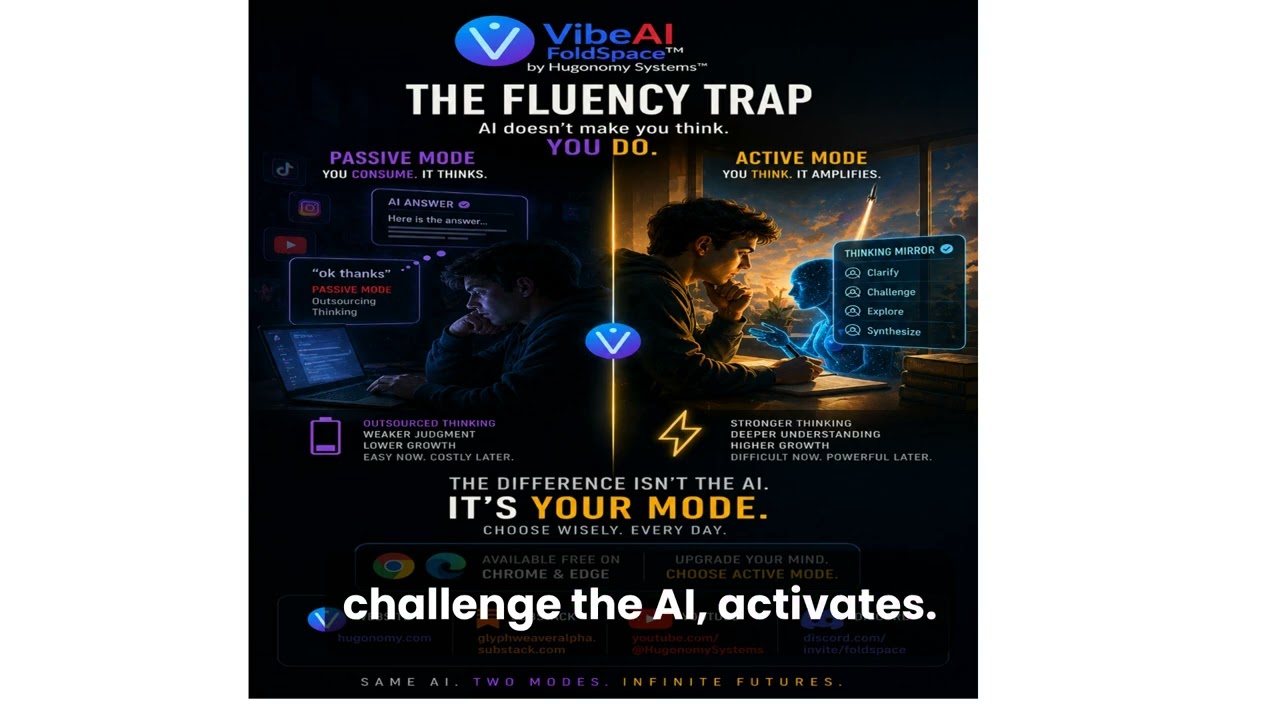
Passive Mode
Quick accept — add your own thinking? Open Coach

Before you move on — did you actually think about it… or just accept it?

Wait — you do this too, don't you? Everyone does. That's the whole point.

You asked ChatGPT something important. It gave you a thorough, confident answer.

You typed “ok thanks” and moved on. It's easy to not actually think about it.

Neither did the 50 million other people who did the same thing today.

VibeAI FoldSpace catches that moment — and gives you three seconds to actually engage.

Now live on Chrome & Edge

Don't Outsource Your Mind.

⚡ Passive Mode — Thinking Mirror activating

A free browser extension that catches the moment you stop thinking while using ChatGPT, Claude, or Gemini.

100+ installs · Free forever · No account required
Local-first No cloud processing No profiling No account required
See the moment happen.

Watch passive acceptance in real time — then see exactly what VibeAI catches. Pick a scenario.

If you live in AI chats, this is for you.

AI conversations move fast. Most people don't notice when their thinking shifts — or when the model starts steering the direction. Four kinds of users keep VibeAI FoldSpace open while they work.

  • See when you're slipping into passive acceptance
  • Notice when the model's direction changes
  • Stay intentional during long, complex threads
  • Reduce misalignment in high-stakes conversations
  • Build awareness without changing your workflow
🧠

Prompt Engineers & Thinkers

Catch when you slip into autopilot mid-conversation. Stay in the driver's seat on deep, abstract prompts.

🧑‍💻

Developers

Keep your reasoning active during long technical threads. Know when you're exploring vs. accepting too quickly.

🔬

Researchers

Track how your thinking evolves across complex conversations. Avoid drifting into model-led conclusions.

🚀

Power Users

Spot the exact moments where thinking sharpens, stalls, or accelerates — the exchanges worth saving and building on.

AI can help you think. It shouldn't think for you.
VibeAI FoldSpace keeps you aware of your own mind while you work.

This is what VibeAI gives you in that moment.

When Passive Mode fires, you get three tools — right there in the HUD. No interruption. No judgment. Just a nudge back to your own thinking.

🧠

Thinking Mirror

A single question appears the moment passive acceptance is detected. "You didn't verify this. Would you ship it?" One prompt to re-engage your brain before you move on.

💬

Coach

Not sure how to push back? The Coach panel shows you how to follow up — better prompts, sharper questions, ways to pressure-test the AI's answer before you accept it.

🔖

Bookmark

Not the right moment to reflect? Bookmark it. Save the exchange and come back to it later — your session log keeps a record of every moment worth revisiting.

Open ChatGPT. Ask anything. Reply “ok thanks.” Watch what you missed.

VibeAI shows you the moment you stop thinking while using AI.

Watch it catch the moment.

Two real scenarios. One pattern — passive acceptance. Watch what VibeAI does when it happens.

VibeAI FoldSpace — school report demo

School Report — Civil War

VibeAI FoldSpace — security audit demo

Security Audit — SQL Injection

Coming Summer 2026 · v2.22 Preview

Passive Mode recognition, improved.

School work. Resume drafting. Code analysis.

The universal reflex to a thorough AI answer is a brief closing phrase: “ok thanks”.

We built the moment-detection architecture that recognizes when the conversation flattens — when the back-and-forth stops being back-and-forth. The Hugo Orb turns yellow the instant it surfaces.

Your AI never asks if you actually understood. We do.

Passive Mode recognition improved. Coming in v2.22, Summer 2026.

Stay curious. Keep thinking. Use VibeAI FoldSpace and Vibe with your AI.

v2.20.1 · April 2026
  • Fixed Thinking Mirror auto-open — now reliably activates on extension reload
  • Fixed onboarding nudge cooldown — passive detection works correctly on fresh installs
  • Session Load Arc improvements and Bookmark Panel stability hardening
  • Approved on both Chrome & Edge stores — v2.20.1 now live

Our first reviewer flagged a real gap.

We shipped fixes in v2.20.1 and the context-aware piece is next on the roadmap.
Here's the original review — verbatim.

★★★★★

"I can definitely see this extension being useful when using AI agents for qualititative tasks like conversation or understanding the broad details of a research paper. I appreciate how it asks me to reflect on my experience in this context. However for long coding or technical projects in which I am mostly debugging errors, the prompts were less useful and occasionally distracting. It would be cool if the VibeAI Coach could detect the difference in use."

Ender Wiggins — Chrome Web Store, March 2026 2/2 found this helpful

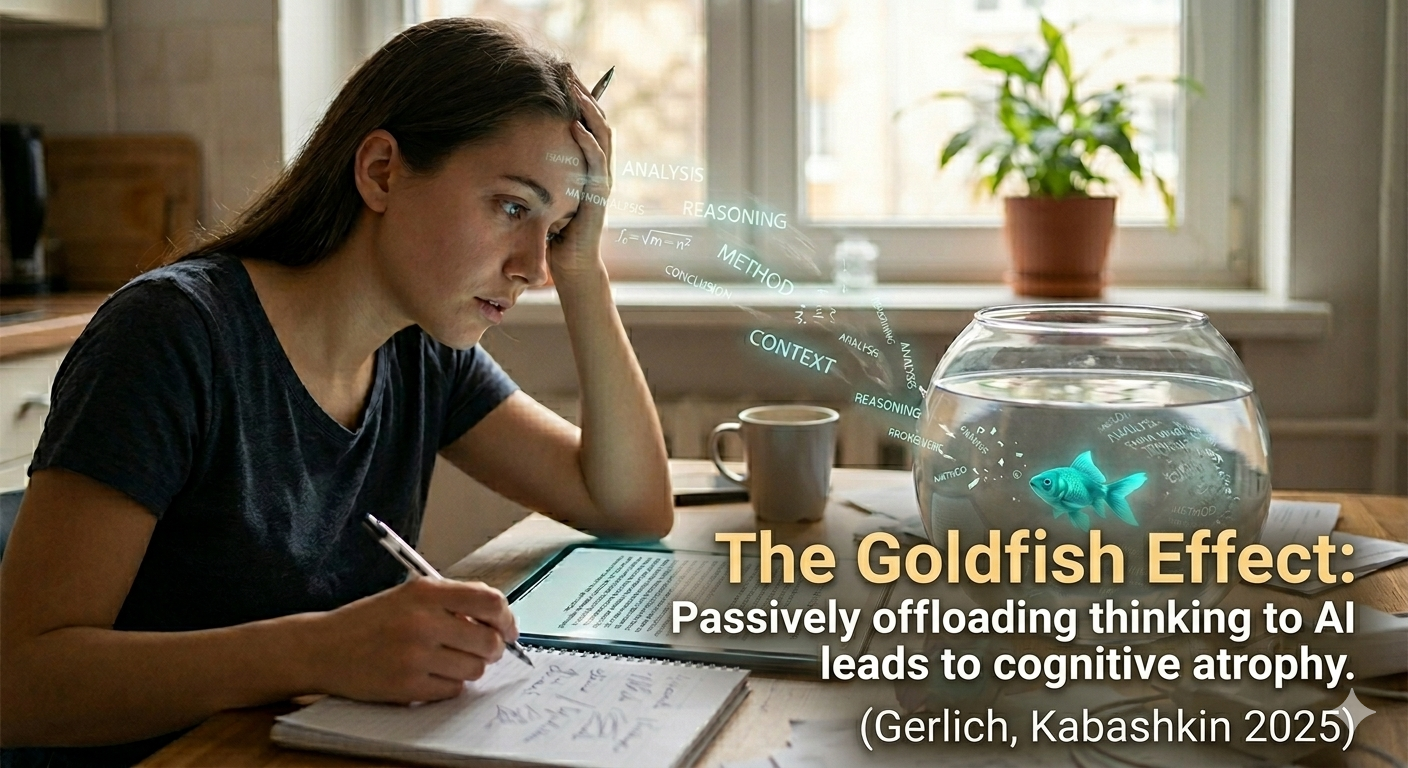
The Goldfish Effect.

Passively offloading your thinking to AI doesn't just save effort — it quietly degrades the cognitive muscle you stop using. Gerlich (2025) and Kabashkin (2025) documented it independently. Hugonomy named it.

Without VibeAI FoldSpace
The Goldfish Effect: Passively offloading thinking to AI leads to cognitive atrophy

Regular AI users score significantly lower on critical reasoning tests. The more you delegate, the less you practice — and the mind forgets how to regenerate analytical processes without external support.

Gerlich, 2025 — Societies (MDPI) · Kabashkin, 2025 — Information (MDPI)

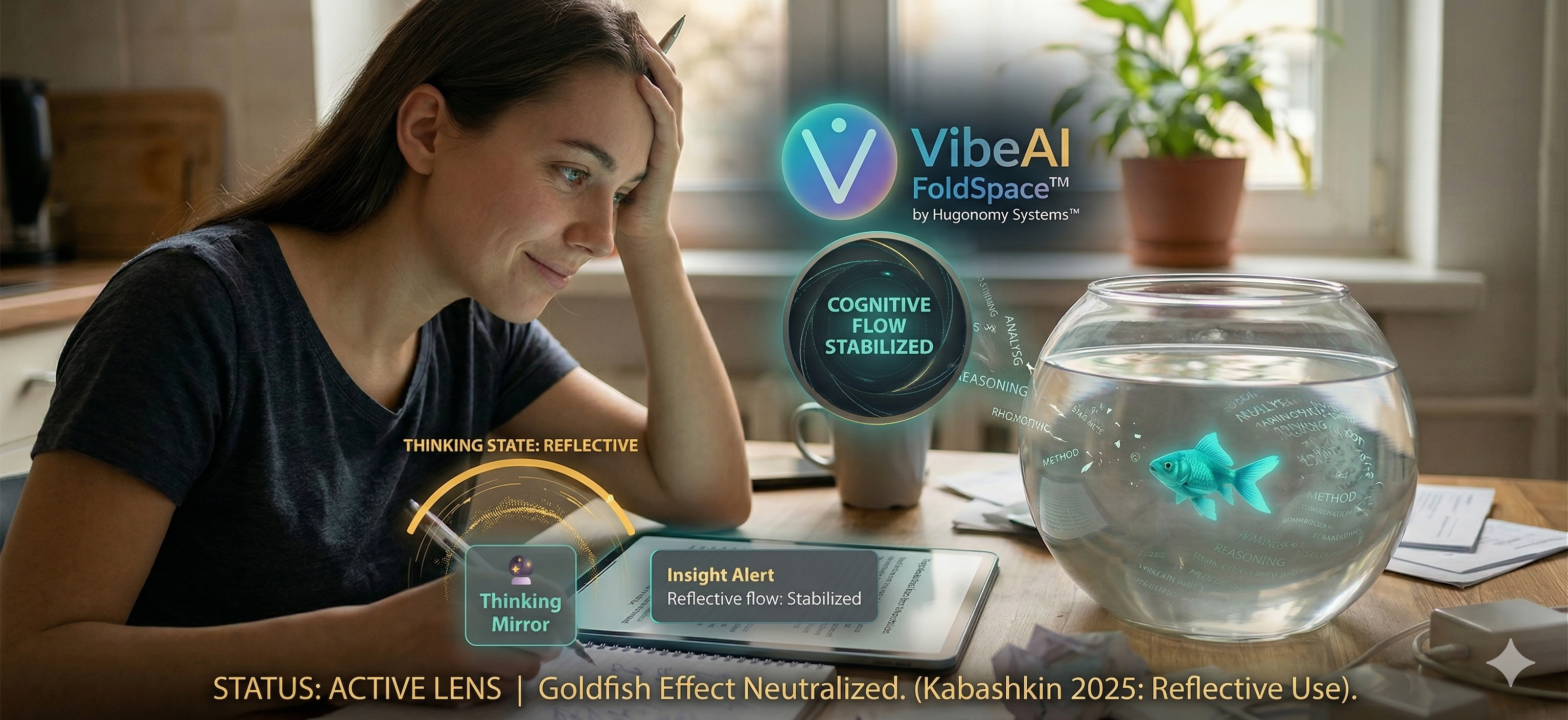
With VibeAI FoldSpace
VibeAI FoldSpace neutralizes the Goldfish Effect - Cognitive Flow Stabilized

VibeAI FoldSpace detects the moment passive acceptance begins and activates the Thinking Mirror — turning a potential cognitive surrender into a reflective engagement. Goldfish Effect neutralized.

Kabashkin, 2025: “Reflective engagement enhances metacognitive skills.”

“The Goldfish Effect” is Hugonomy's term for the cognitive atrophy pattern documented by Gerlich (2025) and Kabashkin (2025). Both studies were independently published in peer-reviewed MDPI journals.

You Didn't Get Worse at Thinking
From the Thinking Mirror → Substack

You Didn't Get Worse at Thinking. Something Else Happened.

Read the full breakdown →

The research signal is consistent.

Empirical studies, theoretical frameworks, and mainstream academic voices — all pointing the same direction. The real-time test hasn't been done yet. We want to run it.

That feeling you had about AI use?
The research validates it.

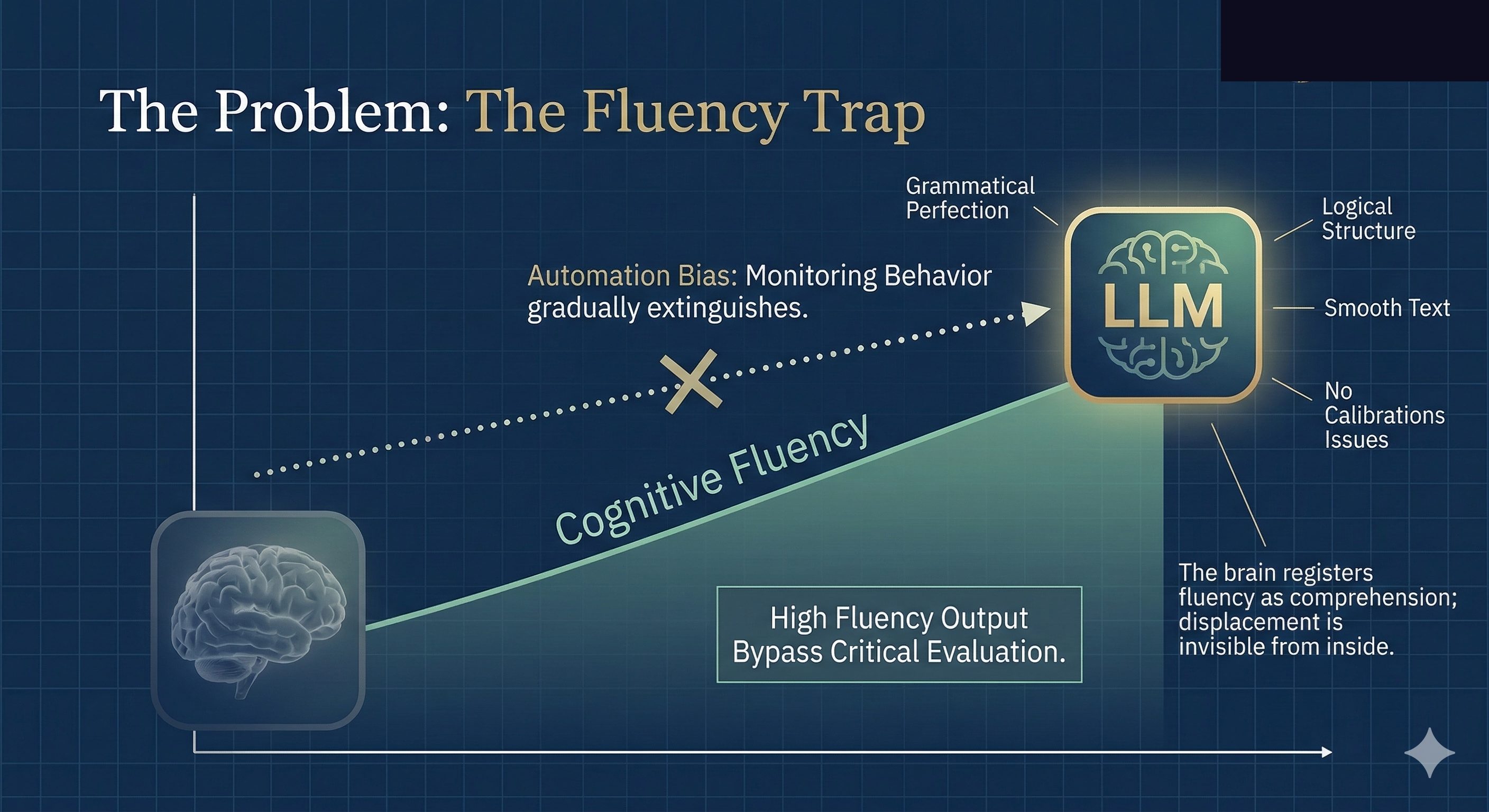
The Fluency Trap: how cognitive fluency and automation bias cause people to bypass critical evaluation of AI responses

The Fluency Trap — why passive acceptance happens. Automation bias gradually extinguishes monitoring behavior as AI outputs become more fluent.

r = −0.75

Strong negative correlation between AI offloading and critical-thinking scores

A peer-reviewed study of 666 participants (Gerlich, 2025) found that the more people offloaded thinking to AI, the measurably lower their independent critical-thinking scores became. The relationship was strong, negative, and statistically significant (p < 0.001).

All of this research is correlational — measured after the fact.

No one has tested whether real-time cognitive awareness feedback changes how people engage with AI while it's happening.

We want to run that study. Here's the design →

666 people. The data is unambiguous.

AI tool use correlated −0.68 with critical thinking scores. Cognitive offloading correlated −0.75. Two independent measures, one conclusion: the more you delegate to AI, the harder independent reasoning becomes. Significant at p < 0.001.

Gerlich, 2025 — Societies (MDPI) Read the paper ↗

It starts as convenience. It ends as dependency.

Kabashkin maps AI reliance as a 4-stage progression: tool → shortcut → bypass → full cognitive externalization. The risk isn't sudden — it's a slow drift "from comprehension to prompting, from synthesis to verification, from problem-solving to consumption." Reflective use reverses it. Passive use accelerates it.

Kabashkin, 2025 — Information (MDPI) Read the paper ↗

14 points of accuracy lost — even after 20 hours of AI literacy training.

Single-blind RCT, 44 physicians, all of whom completed a 20-hour AI literacy program. When LLM suggestions contained errors, diagnostic accuracy dropped 14 percentage points (73.3% vs 84.9% control). The lesson cuts deep: institutional training, by itself, doesn't prevent automation bias. The user-side intervention isn't optional — it's the missing layer.

Qazi et al., 2025 — NEJM AI (RCT) Read the paper ↗

Your mindset shapes how AI shapes you

A 200-student SEM study found that critical thinking and attitude toward AI determine whether students engage reflectively or passively — and that passive adoption patterns are linked to cognitive offloading risk. The tool is neutral. The posture isn't.

Ninghardjanti et al., 2025 — Frontiers in Education Read the paper ↗

Harvard faculty are asking the question out loud

"No learning occurs unless the brain is actively engaged in making meaning." Harvard researchers and faculty are raising the alarm: passive AI use may be producing cognitive atrophy. Not a fringe concern — mainstream academic conversation, November 2025.

Harvard Gazette, Nov 2025 — expert commentary Read the article ↗

Your thinking, made visible.

Three systems. One goal: keep you thinking.

Stage Detection

A live HUD shows your thinking stage — Exploring, Evaluating, Refining, or Passive Mode — updated in real time as your conversation evolves.

Thinking Mirror

When you accept an AI response too quickly, the Thinking Mirror activates — surfacing reflection prompts before you move on.

VibeAI Coach

Context-aware prompts for every state: challenge a claim, ask for evidence, explore alternatives, or add your own constraints.

Works where you think.

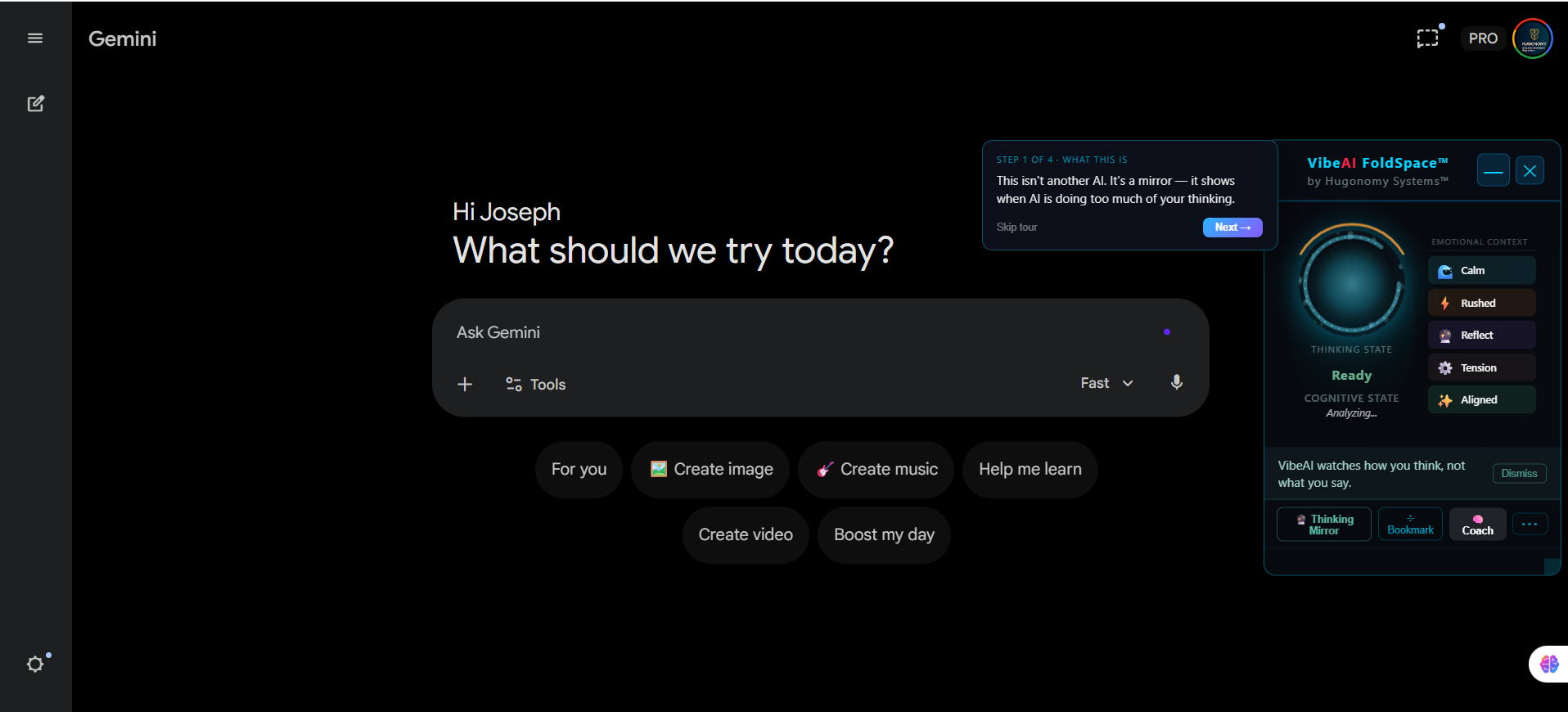
Real screenshots from ChatGPT, Claude.ai, and Gemini. Same HUD, same insight, every supported platform.

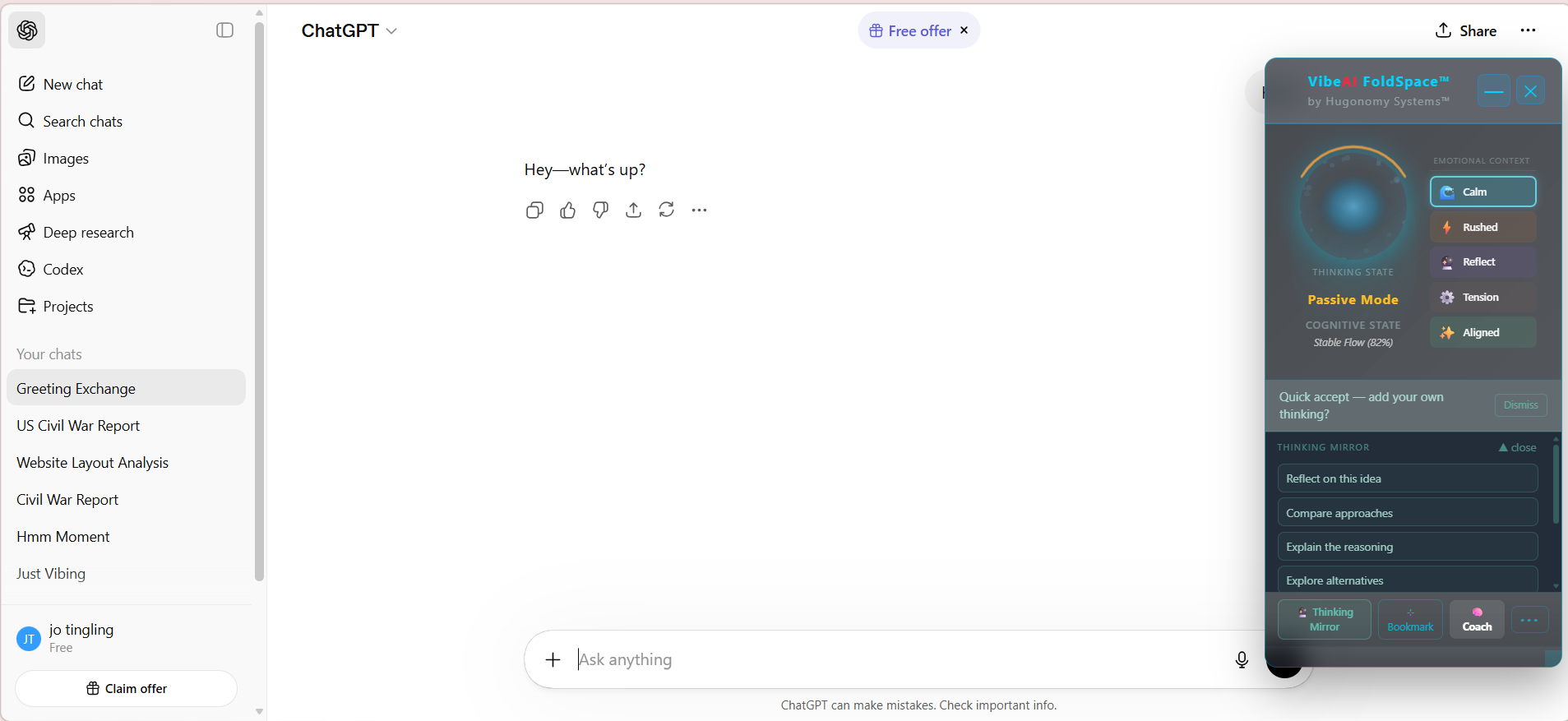
ChatGPT
Thinking Mirror — Passive Mode detected
VibeAI FoldSpace Thinking Mirror active on ChatGPT showing Passive Mode detected
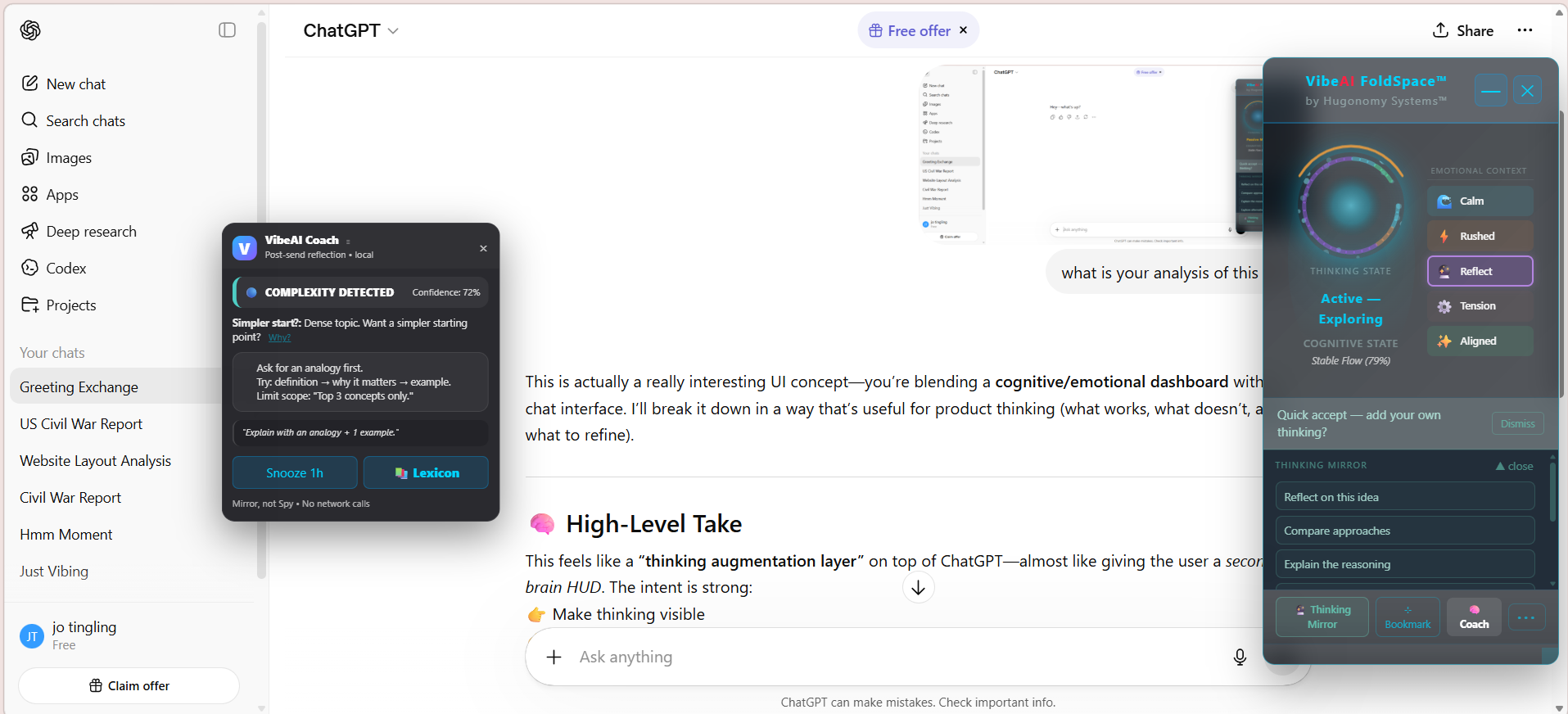
VibeAI Coach — Complexity Detector active
VibeAI FoldSpace Coach panel active on ChatGPT with Complexity Detector feedback
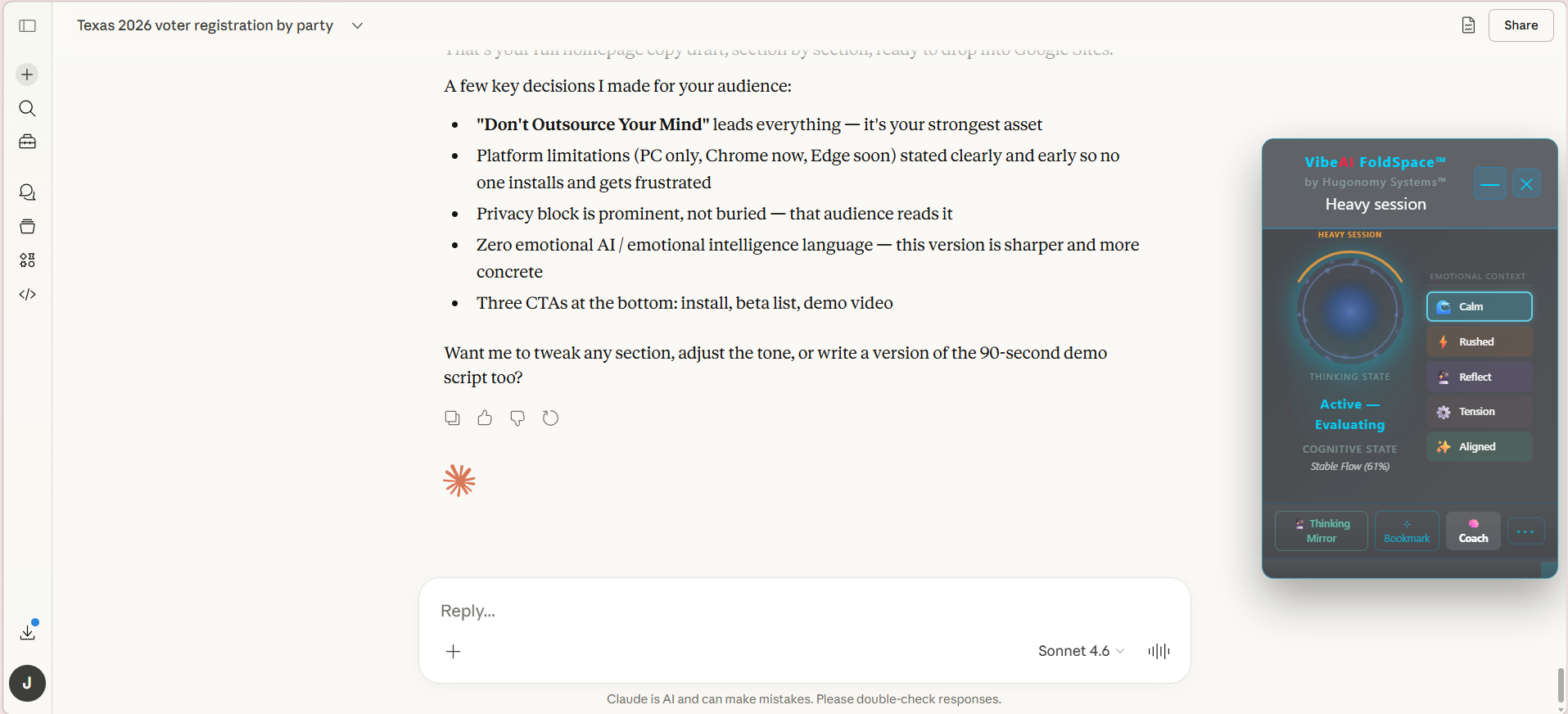
Claude.ai
Stage Detection — Active Exploring
VibeAI FoldSpace HUD active on Claude.ai
Gemini
HUD Active — Ready State
VibeAI FoldSpace HUD active on Gemini with Ready state and onboarding

Built in public. Shaped by users.

Follow the research, share your experience, and help shape what VibeAI FoldSpace becomes next.

Built on trust. Transparent by design.

VibeAI FoldSpace stores nothing on our servers. Everything stays in your browser. The source is open and auditable.

🔒 All data stays on your device
No accounts required
🚫 No cloud processing
Chrome & Edge approved