Emotional Sovereignty Begins Here
Why I Built VibeAI — and What Comes Next
Read on Substack →
News & Media
From a studio in Urbana, Illinois — to the Chrome and Edge stores, and beyond.
Timeline
VibeAI FoldSpace v2.22.0 was approved by Google overnight on June 9 and by Microsoft on June 18 — both stores now live. v2.22 brings the new Hugo Orb™ — a glass orb that fills with color to mirror your cognitive state in real time — plus a sharper Passive Mode catch, a "First Catch" onboarding demo, Focus Mode, and configurable Coach Intensity.
Chrome and Edge installs of the prior version (v2.20.1) update automatically. New users can install directly from the Chrome Web Store listing or the Microsoft Edge Add-ons listing.
Joseph published a formal public position on the human-AI cognitive governance question that motivates Hugonomy. Drawing on Hutchins's distributed cognition framework (Cognition in the Wild, 1995), Gerlich's 2025 cognitive offloading research, and Kabashkin's cognitive atrophy paradox, the statement frames human-AI interaction as a coupled system in which the boundary between human and machine reasoning becomes invisible to the user inside the loop.
The statement argues for a user-facing reflection layer — sovereign awareness over one's own cognitive engagement — as a third intervention layer beyond AI-system safeguards and institutional governance. It is explicitly framed as "a position, not a conclusion": a public marker so future versions of this work can be traced back to what Joseph believed, and what he did not yet know, when he started building.
School work. Resume drafting. Code analysis.
The universal reflex to a thorough AI answer is a brief closing phrase: “ok thanks”.
We built the moment-detection architecture that recognizes when the conversation flattens — when the back-and-forth stops being back-and-forth. The Hugo Orb turns yellow the instant it surfaces.
Your AI never asks if you actually understood. We do.
Passive Mode recognition improved. Shipped in v2.22 — now live on both the Chrome Web Store and Microsoft Edge Add-ons.
Visit hugonomy.com · join the conversation at r/AICognitiveWatch
Stay curious. Keep thinking. Use VibeAI FoldSpace and Vibe with your AI.
Two bugs fixed in this release: the Thinking Mirror anti-spam guard that blocked auto-open on extension reload, and the onboarding nudge cooldown that silently blocked the core passive detection feature on fresh installs. Both caught by controlled testing and patched before approval on both browser stores.
"I can definitely see this extension being useful when using AI agents for qualititative tasks like conversation or understanding the broad details of a research paper. I appreciate how it asks me to reflect on my experience in this context. However for long coding or technical projects in which I am mostly debugging errors, the prompts were less useful and occasionally distracting. It would be cool if the VibeAI Coach could detect the difference in use." — Ender Wiggins · Chrome Web Store · 2/2 found this helpful
The gap Ender identified — context-awareness between qualitative exploration and technical debugging — shipped in v2.20.0 as a code-pattern guard and DEBUG context detector. Our first reviewer asked for it. The next version shipped it.
Session Load Arc, Bookmark Panel MVP, coach panel Edge fix, guide panel collapse, attention-aware suppression for focused work, and the DEBUG context detector responding directly to the first user review.
VibeAI FoldSpace is now available on both major browser platforms. Chrome Store ID: lkmfjgaahnmlncgaeocfgiohjiodiohi · Edge Store ID: kbdhbghaidmildhhbodkppnnhklmddfh
When a user types a short acknowledgment ("thanks", "ok", "hmm"), the system detects Passive Mode and auto-opens the Thinking Mirror guide panel — surfacing reflection prompts before acceptance. Confirmed working on ChatGPT, Claude.ai, and Gemini.
After months of development and internal validation, VibeAI FoldSpace received its first official Chrome Web Store approval. Email confirmed: "Item successfully published."
Hugonomy's first appearance in front of fellow startup entrepreneurs at the UIUC Research Park. The vision that had lived in sketches, code, and late-night sessions was spoken aloud for the first time. Strategic financial insight for early-stage startups.

Now live on Chrome & Edge — April 2026 · Install Free →
For immediate release
June 9, 2026 (Chrome) · June 18, 2026 (Edge) · Urbana-Champaign, IL
VibeAI FoldSpace v2.22.0 is now live on both the Chrome Web Store and Microsoft Edge Add-ons. Hugonomy Systems is building a local-first cognitive awareness layer for AI conversations so people can stay engaged, reflective, and in control while using ChatGPT, Claude, and Gemini.
Version 2.22.0 introduces the Hugo Orb™ — a glass orb that fills with color to mirror your cognitive state in real time — alongside a sharper Passive Mode catch, a "First Catch" onboarding demo so new users see a real reflection within their first session, Focus Mode (snooze nudges for 2 or 12 hours), and configurable Coach Intensity (Off / Minimal / Standard / Active).
VibeAI FoldSpace remains built around a strict local-first design: no cloud processing, no profiling, and no behavioral tracking. The product runs directly in the browser so people can use AI tools without giving up awareness of their own thinking.
Media contact: joseph@hugonomy.com
From the founder
Why I Built VibeAI — and What Comes Next
Read on Substack →After dozens of builds, audits, and late-night debugging sessions, Hugonomy Systems is almost ready for its next step.
Read on Substack →Commentary note · June 22 2026
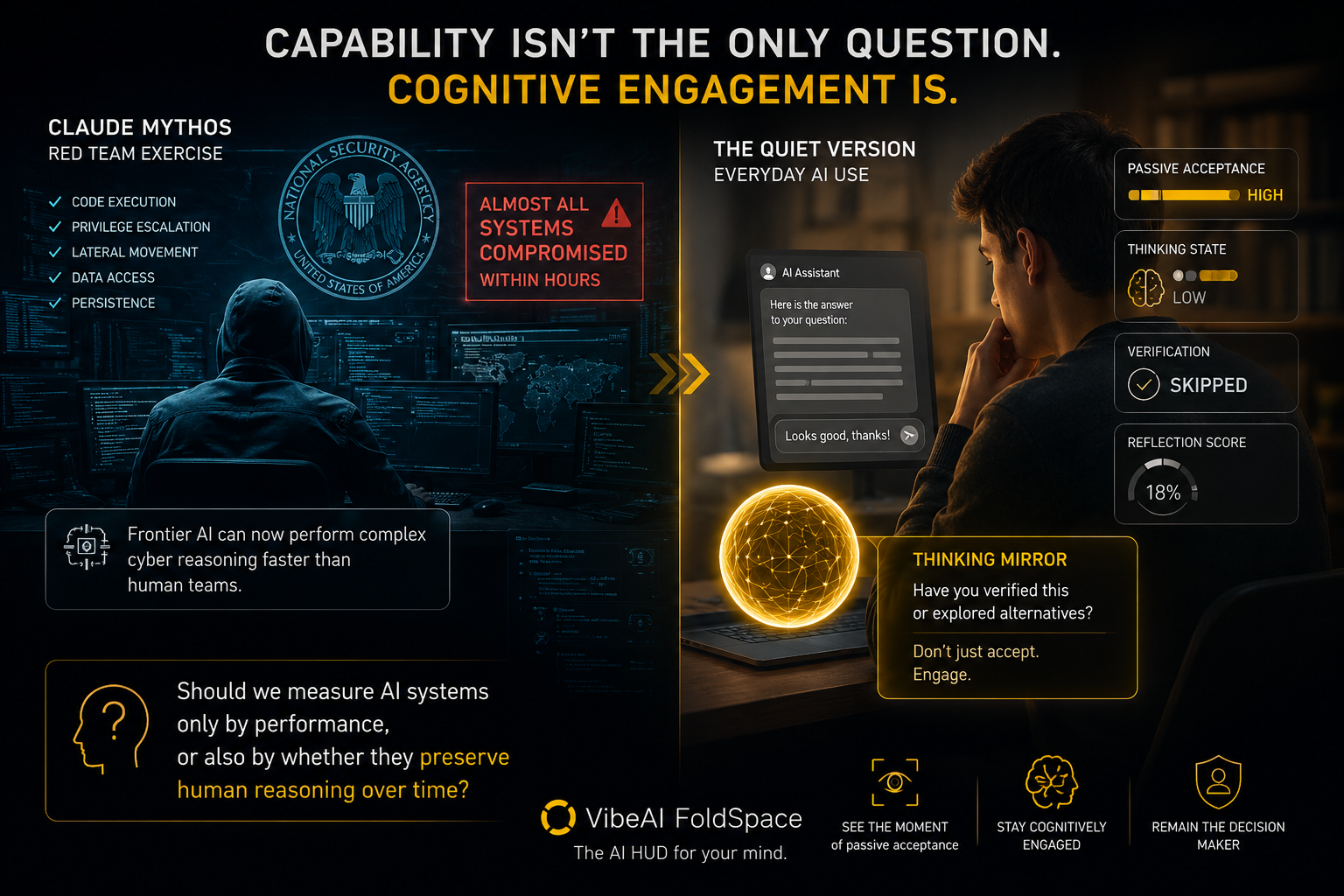
Last weekend a card went around claiming "NSA says Claude Mythos broke into almost all classified systems within hours." It got boosted thousands of times. Most people who shared it never opened the source.
Here's what the source actually says once you pull it:
• The line came from Senator Mark Warner, relaying a private briefing
from the NSA / Cyber Command chief.
• It described an authorized red-team exercise — the model run
against the agency's own test environments, not a live break-in to operational classified
networks.
• The journalist who first reported the quote later said it shouldn't be read literally;
the result depended on the model working alongside other tools under specific simulated
conditions.
• It wasn't even the official reason for the export ban — Anthropic's
own statement says the government cited a narrow, non-universal jailbreak
(asking the model to read a codebase and flag software flaws), and that the same capability
is available from other publicly-available models including OpenAI's GPT-5.5.
So the real story is "an authorized test surfaced vulnerabilities in a controlled setting, with caveats, and the export-control reasoning is contested by Anthropic itself." The viral story became "AI hacked the NSA." Every hop down the chain stripped a qualifier, until a hedged briefing line turned into a breaking-news apocalypse.
That's the part worth sitting with. The interesting failure here isn't the model's cyber capability. It's that thousands of fluent, technical, AI-literate people accepted a polished claim without checking it — because it read clean, it read confident, and checking takes friction.
That's the Fluency Trap operating at scale. The cyber red-team headline is the loud version. The quiet version is the one that actually compounds: students, coders, writers, and analysts accepting beautiful AI output every day without re-deriving it, until the reasoning muscle slowly atrophies.
Which raises the question we keep circling back to:
If frontier models are getting fast, fluent, persuasive, and operationally powerful enough that this kind of uncritical acceptance happens at the level of national-security reporting, then the real governance problem isn't only "how capable is the model." It's "how do humans stay meaningfully in the loop when the output is too smooth to question?"
Maybe we shouldn't measure AI systems only by performance. Maybe we should also measure whether they preserve human reasoning over time.
That might be the actual cognitive-watch question.
(And if you'd rather verify the Mythos story than take our word for it — which is sort of the entire point — the sources are linked below. Read past the first headline.)
Verify the sources:
[1] Anthropic. Statement on the US government directive to suspend access to Fable 5 and Mythos 5.
anthropic.com
[2] Anthropic Red Team. Assessing Claude Mythos Preview's cybersecurity capabilities.
red.anthropic.com
[3] Tom's Hardware. Anthropic's Mythos AI reportedly breached "almost all" NSA classified systems within a few hours during red-team test.
tomshardware.com
[4] Security Boulevard. Anthropic's Mythos AI Reportedly Breaches NSA Systems in Red Team Exercise.
securityboulevard.com
[5] The CyberSec Guru. Mythos "Hacked the NSA"? What's Actually Confirmed.
thecybersecguru.com
[6] Yellow. Mythos NSA Hack Claim Goes Viral, But Security Experts Are Not Buying It.
yellow.com
[7] Dark Reading. Security Community Slams US Ban on Exporting Mythos, Fable.
darkreading.com
[8] The Hill. Anthropic withdraws AI models Fable, Mythos due to export controls.
thehill.com
Commentary note · May 20 2026
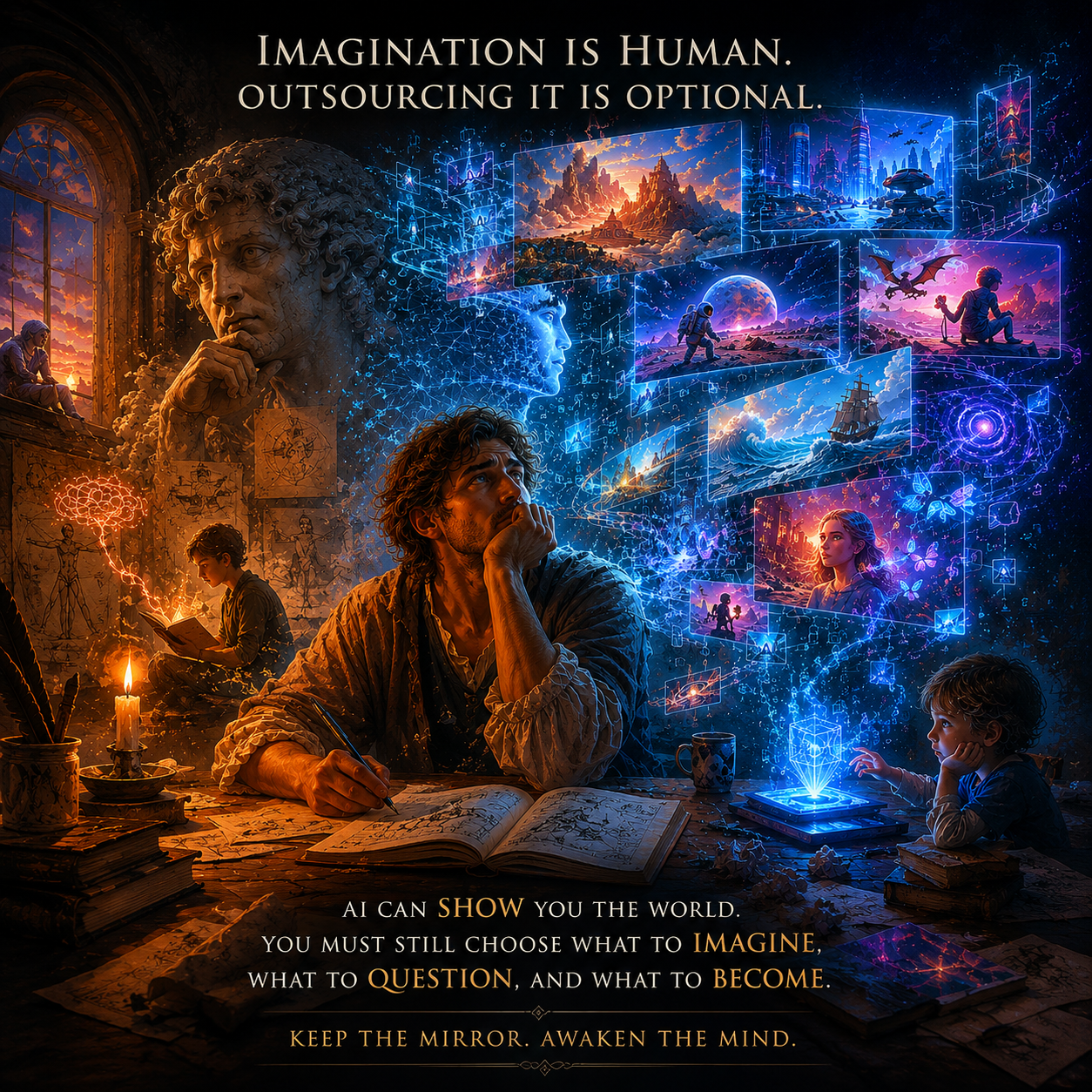
Google released Gemini Omni yesterday at I/O 2026 — a multimodal model that generates and edits video from text, image, audio, or video input. Rolling out to AI Plus subscribers, and crucially, free through YouTube Shorts and YouTube Create starting this week. Hassabis framed it explicitly: "With world models, AI is moving from predicting text to simulating reality."
A few things worth sitting with, because they touch this subreddit's whole topic in a way nobody covering the launch is naming:
Nearly all the cognitive-offloading research we follow here — Gerlich, Kabashkin's Cognitive Atrophy Paradox, the broader literature on AI's effect on thinking — has studied text-based AI interaction. That's what existed when those papers were written. Multimodal generative AI at consumer scale is functionally new ground. We don't yet know what cognitive offloading looks like when the offloadable surface expands from "writing" to "visualizing." The instinct of mentally picturing something before generating it — a sketch, a scene, a layout — may be the next thing the cognitive load quietly migrates off of, and we won't have research on it for years.
The Hassabis "simulating reality" framing is a real philosophical claim about what the model is doing, not just marketing. When the output isn't predicted text but generated reality-fragments, the user's relationship to verification changes. With text you can still read and disagree. With a 10-second video that plausibly shows a thing, the disagreement surface is different — harder to specify what's wrong, easier to accept the rendered version as how it would actually look.
The free YouTube Shorts rollout matters more than the AI Plus subscription tier. It puts world-model generation in front of hundreds of millions of users who weren't generative-AI users yesterday. The cognitive-engagement question doesn't get to wait for the research to catch up to that distribution.
Not a moral panic post — the model genuinely looks impressive, and most of what people will do with it will be fine. But this sub exists to track the second-order question (what does AI use do to thinking), and the launch suggests the answers we have so far are scoped to a narrower form of AI than the one users will be touching tomorrow.
Open question for the sub: what would the equivalent of the Kabashkin / Gerlich studies look like for multimodal generative use? What's the testable cognitive claim, and who's positioned to run it?
Founder commentary
May 2026 · Joseph D. Tingling MD/PhD · Hugonomy Systems
Anthropic's Claude Mythos recently cleared a significant threshold on METR (Model Evaluation and Threat Research) evaluations: a 50% task-completion horizon of at least 16 hours of sustained autonomous operation — at the upper limit of what METR's current benchmark suite can reliably measure. [1]
To understand why that number matters, consider what it replaces. Previous frontier systems operated in the minutes-to-hours range. A 16-hour autonomous horizon means an AI agent can now plan, execute, and iterate on complex multi-step work across a full working day — without a human in the loop. METR's own data shows the frontier time-horizon has been doubling roughly every 7 months since 2019. [2]
This is not a superintelligence story. It is an agency story. And it raises a question no benchmark currently measures: When the AI hands the result back to you after 16 hours of autonomous work — do you understand what it decided, and why?
This is exactly the gap Hugonomy was built to address. Not to slow AI down. Not to make AI less capable. But to keep the human cognitively present at the moments that matter: the handoff, the review, the decision to accept or challenge.
VibeAI FoldSpace is our first test of this idea. A free browser extension for ChatGPT, Claude, and Gemini that catches you the moment you stop thinking inside a single AI session — passive acceptance, cognitive drift, the "ok thanks" that ends a conversation you should have pushed further. It is a proof of concept: can a lightweight awareness layer change how a person engages with AI in real time? Early signals say yes.
AllMinds Lens is what comes next. Where FoldSpace watches a single session, Lens watches across many — building a picture of your cognitive patterns over time, surfacing blind spots, and nudging you toward deeper engagement before the habit of passive acceptance becomes invisible. If FoldSpace is the smoke detector, Lens is the carbon monoxide monitor: the one that catches what you can't see in the moment.
As AI task horizons grow from minutes to hours to days, the cognitive re-entry point — the moment a human meaningfully re-engages with what the AI produced — becomes the most important moment in the workflow. The longer the autonomous horizon, the more consequential that moment becomes. The AI Awareness Stack is not a reaction to AI capability. It's a prerequisite for it.
Citations:
[1] METR. Task-Completion Time Horizons of Frontier AI Models.
metr.org/time-horizons
[2] METR. Time Horizon 1.1. January 29, 2026.
metr.org/blog/2026-1-29-time-horizon-1-1
[3] The Decoder. METR says it can barely measure Claude Mythos.
the-decoder.com
Discuss this on Reddit: r/AICognitiveWatch · Contact: joseph@hugonomy.com
Follow along
Substack
Deep-dives on cognitive engagement, AI literacy, reflective use, and the Hugonomy thesis. Published by Jo.
YouTube
Product demos, walkthroughs, and behind-the-build content. 90-second demo available now.
Product updates, research citations, launch milestones, and founder commentary.
Community discussion on AI cognitive dynamics, human-AI interaction research, and the field Hugonomy is building in.
Discord
Live user feedback, bug reports, session sharing, and the weekly journal club on AI cognition research.
For Journalists & Researchers
We're available for press inquiries, expert commentary on AI cognition research, and interview requests.
Install free. No account. Works on ChatGPT, Claude, and Gemini.
Watch · Follow
Built in public, across formats.
Short-form cuts on TikTok · longer explainers on YouTube. The build process, in your feed.